

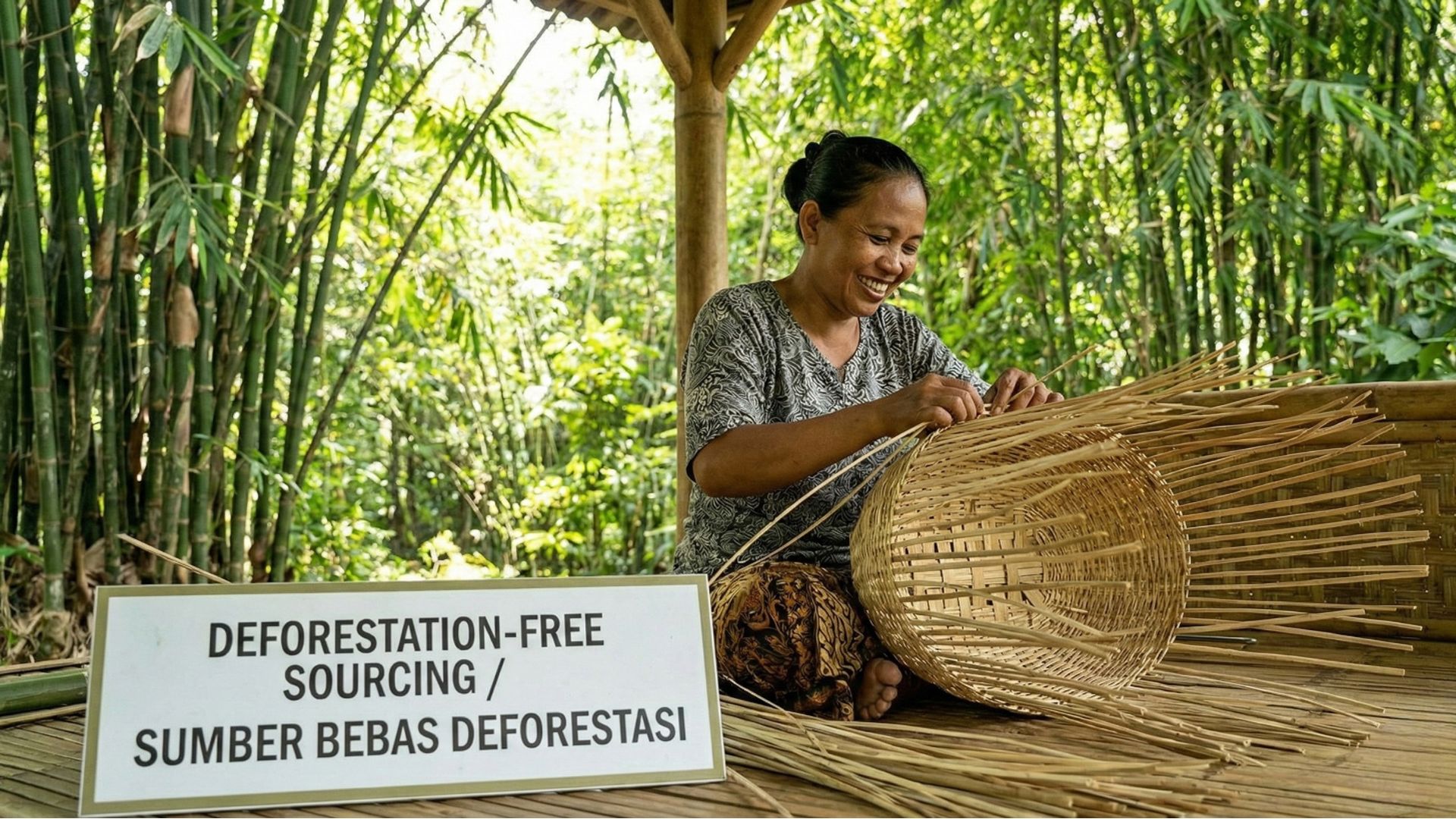
Deforestation-Free Sourcing Practices in Indonesian Sustainable Handicraft Manufacturing
Deforestation remains one of the most critical environmental risks within global supply chains that depend on natural raw materials. In response, sustainable handicraft manufacturing in Indonesia increasingly adopts deforestation-free sourcing practices to ensure environmental responsibility, regulatory compliance, and long-term material availability.
For international buyers—particularly those operating under European Union and North American sustainability regulations—deforestation-free sourcing is no longer optional. It is a prerequisite for transparency, risk mitigation, and alignment with evolving anti-deforestation frameworks.
What Does Deforestation-Free Sourcing Mean?
Deforestation-free sourcing refers to the procurement of raw materials that do not contribute to forest degradation or illegal land conversion. In the context of Indonesian handicrafts, this approach combines traditional material knowledge with modern supply chain governance.
Key principles include:
- Legal and Responsible Sourcing Practices
All materials are sourced through legally compliant channels, ensuring alignment with national forestry laws and local land-use regulations. This reduces legal exposure for international buyers and supports responsible forest governance.
- Traceability of Raw Materials
Traceability enables buyers to identify:
- The origin of raw materials
- The harvesting or collection method
- The communities involved in the supply chain
This transparency is essential for compliance with regulations such as:
- EU Deforestation Regulation (EUDR)
- Due diligence requirements in North America
Prioritization of Renewable and Low-Impact Materials
Indonesian handicraft production emphasizes renewable, reclaimed, or plantation-grown materials, reducing dependency on natural forest extraction.
Common material categories include:
- Rapidly renewable plant fibers
- Agricultural by-products
- Non-timber forest products
This approach supports circular material use while preserving biodiversity.
Verified Sources of Sustainable Raw Materials in Indonesia
Indonesia’s diverse geography enables localized, low-impact sourcing across multiple regions:
- Water Hyacinth (Eceng Gondok)
Sourced from Demak, Central Java
→ An invasive aquatic plant repurposed into value-added craft materials - Banana Sheath (Pelepah Pisang)
Sourced from Bondowoso and Kebumen
→ Agricultural by-product with no additional land clearing - Pandan Leaves
Sourced from Tasikmalaya and Yogyakarta
→ Naturally renewable fiber traditionally harvested without deforestation - Mendong Grass
Sourced from Minggir, Special Region of Yogyakarta (DIY)
→ Fast-growing wetland plant with low ecological footprint - Rattan
Sourced from Minggir, DIY
→ Non-timber forest product supporting forest conservation when responsibly managed - Bamboo
Sourced from Playen, Gunungkidul, DIY
→ Highly renewable material with strong carbon sequestration properties
Compliance with Anti-Deforestation Regulations
Deforestation-free sourcing directly supports compliance with:
- International sustainability standards
- Anti-deforestation trade regulations
- Corporate ESG and due diligence frameworks
For global buyers, this ensures:
- Reduced reputational risk
- Supply chain resilience
- Alignment with sustainability commitments and reporting requirements
Why Deforestation-Free Sourcing Matters for Global Buyers
For international buyers navigating anti-deforestation regulations and increasing supply chain transparency requirements, working with sourcing partners that provide verified and traceable materials is no longer optional—it is a business necessity. To mitigate compliance risk and ensure responsible sourcing, many global brands now prioritize partners with documented material origins and regulatory alignment—learn how Craftnesia supports deforestation-free handicraft sourcing for global B2B buyers.
By integrating legal sourcing practices, material traceability, renewable resources, and alignment with anti-deforestation frameworks, Indonesian sustainable handicraft manufacturing offers a low-risk, future-ready supply chain. This approach enables buyers to meet evolving environmental and regulatory expectations with confidence.
At the same time, deforestation-free sourcing in Indonesia does not come at the expense of craftsmanship or design integrity. Traditional materials and time-honored production methods remain central to the process, allowing global buyers to maintain cultural value, aesthetic quality, and design flexibility while advancing responsible global trade.


