

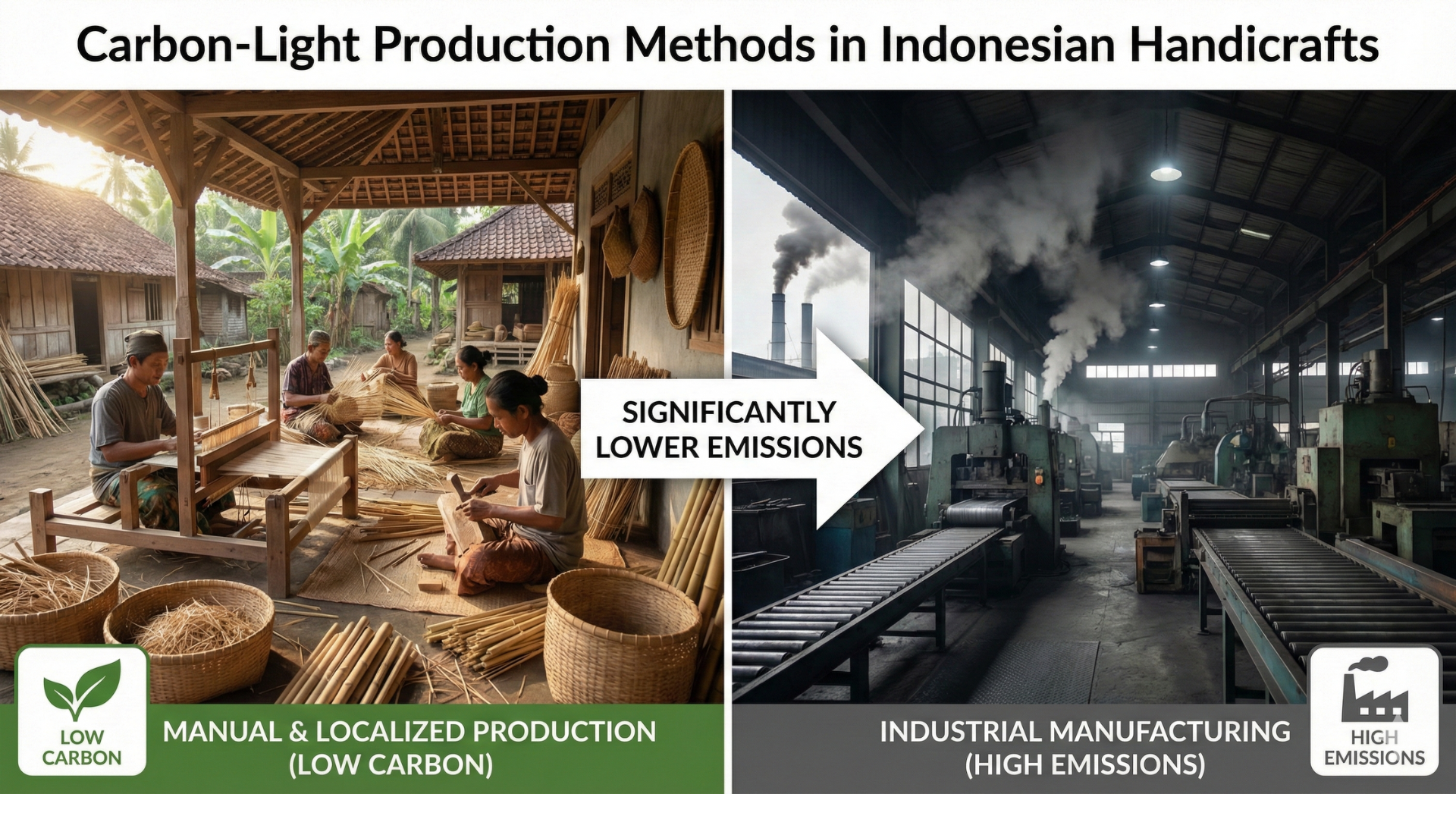
Carbon-Light Production Methods in Indonesian Sustainable Handicraft Manufacturing
One of Indonesia’s strongest sustainability advantages lies in its carbon-light production model, particularly within the handicraft manufacturing sector. Unlike mass industrial production, Indonesian handicrafts are produced through decentralized, community-based systems that naturally limit energy consumption and greenhouse gas emissions.
This production model aligns closely with the principles of green business practices and community-based circular economies, making it increasingly relevant for global brands seeking to reduce environmental impact across their value chains.
Characteristics of Carbon-Light Handicraft Production
Indonesian sustainable handicraft manufacturing is typically characterized by:
- Small-scale, decentralized workshops
Production is distributed across local artisan communities rather than centralized factories, reducing energy intensity and logistical emissions. - Manual and semi-manual production methods
Craft-based processes rely primarily on human skill and craftsmanship, minimizing dependence on fossil-fuel-intensive machinery. - Localized supply chains
Raw materials are sourced near production sites, reducing transportation distances and associated carbon emissions. - Limited reliance on high-energy machinery
The absence of heavy industrial equipment significantly lowers electricity and fuel consumption.
Together, these characteristics form a production ecosystem that is inherently low-carbon by design.
Manual and Semi-Manual Production as a Low-Emission Advantage
Manual and semi-manual manufacturing methods are often perceived as traditional, yet from a sustainability perspective, they represent a structural advantage. By prioritizing skilled labor over automation, Indonesian handicraft production achieves:
- Lower operational energy demand
- Reduced dependence on fossil fuels
- Minimal process-related emissions
This approach contrasts sharply with mass manufacturing systems that rely on continuous high-energy inputs and carbon-intensive infrastructure.
Energy Efficiency and Carbon Reduction
Energy efficiency in carbon-light handicraft production is achieved through:
- Minimal electricity usage
- Low-temperature processes
- Absence of large-scale mechanized systems
As a result, overall emissions per unit are significantly lower when compared to industrial manufacturing benchmarks.
Comparing Emissions: Handicraft vs. Mass Manufacturing
When compared to mass industrial manufacturing, carbon-light handicraft production offers:
- Substantially lower Scope 1 and Scope 2 emissions
- Reduced Scope 3 emissions due to localized sourcing
- Lower embodied carbon across the product lifecycle
For brands increasingly focused on Scope 3 emission reduction, sourcing from carbon-light production systems becomes a strategic decision rather than a niche sustainability claim.
Carbon-Light Production and the Green Community Economy
Beyond emissions reduction, carbon-light production supports green business models rooted in community economies. Decentralized workshops create:
- Local employment opportunities
- Resilient community-based production systems
- Economic value without environmental overexploitation
This integration of sustainability and community empowerment strengthens long-term supply chain stability.
Why Carbon-Light Production Matters for Global Buyers
As environmental accountability expands across global supply chains, carbon-light production methods offer international buyers a measurable pathway to reduce emissions while maintaining product quality and cultural authenticity. By sourcing from Indonesian handicraft manufacturers, buyers gain access to a low-carbon, community-driven production model aligned with evolving ESG and sustainability expectations.


