

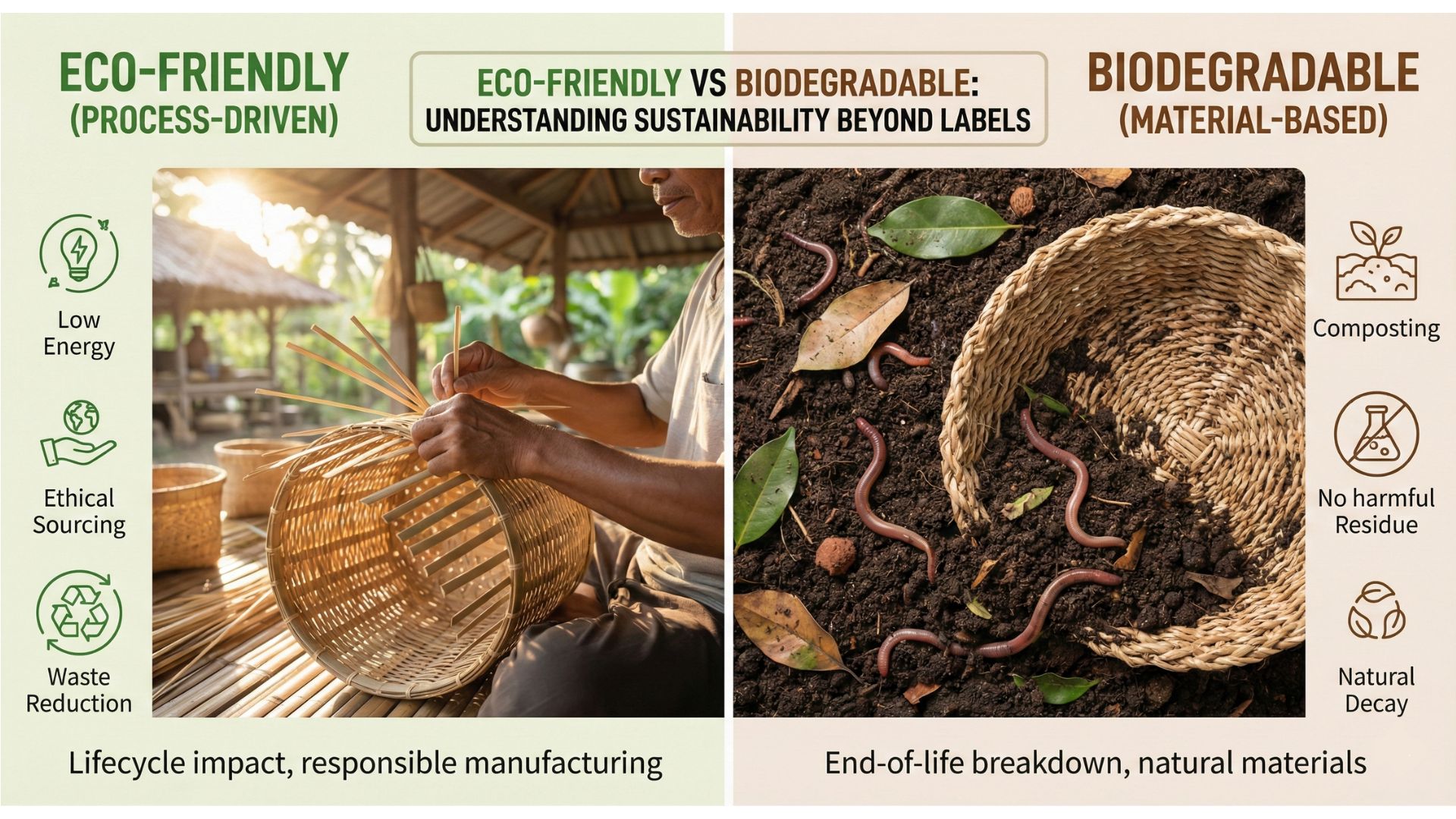
Eco-Friendly vs Biodegradable: Understanding Sustainability Beyond Labels
In global trade, sustainability terminology is increasingly central to sourcing decisions, regulatory compliance, and brand credibility. However, within industries such as handicraft and home décor, these terms are often misunderstood, misused, or applied interchangeably. Two of the most frequently confused concepts are eco-friendly and biodegradable.
While both relate to environmental responsibility, they address very different dimensions of sustainability. Understanding the distinction is essential for handicraft producers, exporters, and global buyers seeking clarity beyond marketing labels.
The Growing Confusion Around Sustainability Terminology

As sustainability becomes a commercial imperative, terminology has evolved faster than shared understanding. Many products are labeled “eco-friendly” or “biodegradable” without sufficient explanation of what exactly is sustainable, how, and at which stage of the product lifecycle.
This lack of clarity has led to:
- Inconsistent sustainability claims
- Eroding trust among international buyers
- Increased scrutiny from regulators and auditors
For handicraft businesses operating in global markets, precision in language is no longer optional—it is part of professional compliance and long-term competitiveness.
What Eco-Friendly Means in Handicraft Manufacturing
The term eco-friendly refers to a process-driven approach to reducing environmental impact across the full lifecycle of a product. In sustainable handicraft manufacturing, this typically includes:
- Responsible and traceable sourcing of raw materials
- Low-energy or manual production methods
- Efficient use of water and natural resources
- Waste minimization and material reuse
- Reduced emissions during production and finishing
Eco-friendly does not describe a single material attribute. Instead, it evaluates how a product is made, not only what it is made from.
In many traditional handicraft systems, eco-friendly practices are embedded by design. Manual craftsmanship, decentralized workshops, and small-batch production naturally consume less energy and generate fewer emissions compared to industrial-scale manufacturing.
Understanding Biodegradable Materials: Scope and Limitations
Biodegradable refers specifically to a material’s ability to break down naturally through biological processes without leaving harmful residues in the environment.
Common biodegradable materials in handicraft manufacturing include:
- Bamboo
- Rattan
- Natural fibers
- Banana sheath
- Responsibly sourced wood
While biodegradability is an important environmental attribute, it represents only one stage of sustainability: end-of-life impact. A product may be biodegradable yet still environmentally harmful if other stages of its lifecycle are problematic.
For example, biodegradable materials can still be unsustainable when:
- Sourced from deforested or illegal land
- Processed using high-energy industrial systems
- Treated with toxic chemicals or finishes
This distinction is critical for buyers evaluating sustainability beyond surface-level claims.
Common Mistakes in Sustainability Claims
One of the most common issues in global handicraft trade is oversimplified sustainability labeling. Typical mistakes include:
- Calling a product eco-friendly solely because it uses natural materials
- Claiming biodegradability without addressing chemical treatments
- Using sustainability language without operational or data-based support
Such claims may attract short-term attention but pose long-term risks. As international markets increasingly demand transparency and verification, vague or misaligned terminology can undermine brand credibility and buyer confidence.
For sustainable handicraft businesses, clarity is not just ethical—it is strategic.
Sustainability as an Integrated System
True sustainability is not achieved through isolated attributes but through systemic alignment. In handicraft manufacturing, this means aligning:
- Material choice
- Production methods
- Environmental impact
- Social responsibility
Indonesia provides a strong example of this integrated approach. Traditional materials such as bamboo, rattan, natural fibers, and responsibly sourced wood are inherently biodegradable. At the same time, artisanal production methods are typically low-impact, labor-intensive, and resource-efficient.
This integration allows sustainability to emerge organically, without reliance on energy-intensive industrial solutions that may increase carbon emissions under the guise of innovation.
Why Terminology Matters for Handicraft Businesses
For handicraft producers and exporters, accurate sustainability terminology is directly linked to:
- Buyer trust and long-term partnerships
- Export compliance and market access
- ESG reporting alignment
- Brand positioning in premium markets
Misusing terms such as eco-friendly or biodegradable does not merely create confusion—it can lead to misaligned expectations and commercial friction.
Clear language, supported by real practices, enables businesses to communicate sustainability with confidence and credibility.
Relevance for Global Buyers and Trade Partners
Global buyers increasingly evaluate suppliers not only on product quality and price but also on how sustainability is defined, implemented, and verified.
Understanding the distinction between eco-friendly and biodegradable allows buyers to:
- Assess sustainability claims more accurately
- Align sourcing decisions with corporate ESG goals
- Reduce reputational and compliance risks
For this reason, sustainability communication must evolve from labels to evidence-based narratives.
Beyond Labels: Communicating Sustainable Handicraft with Integrity
Moving beyond labels means focusing on:
- Transparent sourcing practices
- Low-impact production methods
- Measurable environmental indicators
- Clear and honest communication
When sustainability is positioned through systems rather than slogans, it strengthens both market credibility and long-term resilience.
This approach reinforces Indonesia’s position as a global hub for sustainable handicraft manufacturing—where sustainability is not retrofitted for marketing, but embedded in tradition, process, and accountability.
For global buyers seeking clarity beyond sustainability labels, it is increasingly important to work with sourcing partners that combine transparent practices with verified production systems—learn how Craftnesia supports verified sustainable handicraft sourcing for international B2B buyers.

